--- title: "Airport Passenger Flow Analytics Guide | Fortune AI" description: "Measure airport queues, wait time, throughput, occupancy, and active service capacity from existing terminal cameras and operating records." canonical: https://www.fortuneai.app/resources/airport-passenger-flow-analytics/ language: en --- [Resources](https://www.fortuneai.app/resources/) / Airport passenger flow analytics # Airport passenger flow analytics A terminal queue can lengthen even while nearby desks sit open. Compare arrivals, active lanes, processing time, and waiting within the same flight wave to locate the pinch point. 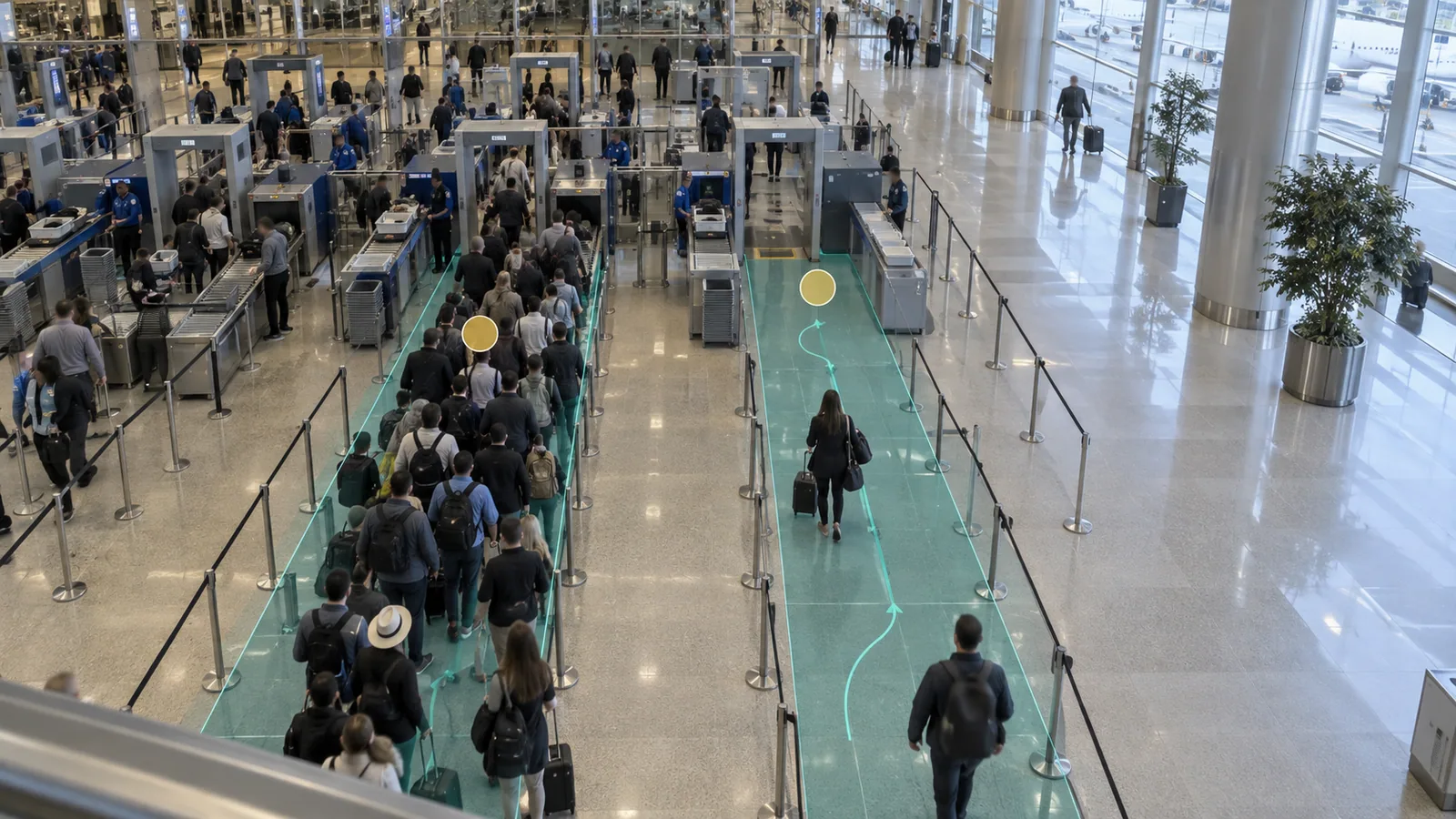 On this page [The approach](#airport-flow-answer)[Terminal zones](#airport-zones)[Metrics](#airport-metrics)[Cameras and data](#airport-cameras)[Pilot plan](#airport-pilot) ## Read demand against capacity A useful terminal view shows arrivals, queue length, wait time, completed processing, and active lanes in the same interval. That makes it easier to tell a flight-wave surge from a lane closure, slow processing, or a blocked route. 01 · Map the journey ## Start where a team can change the flow ### Check-in and bag drop - Passenger arrivals and queue growth - Active desks, kiosks, and service points - Wait and processing intervals ### Security and border queues - Queue length, spillover, and throughput - Active lanes during each demand wave - Operational timing only—not security-risk decisions ### Gates and public areas - Boarding queues and gate-area occupancy - Concourse, lounge, and retail-zone dwell - Congestion near circulation routes Start with one zone where the operating team can change lane coverage, staffing, routing, or opening time. Do not combine unrelated terminal areas into one average. 02 · Define the metrics ## Keep queues, throughput, and capacity together Match each operating question to the metric and evidence needed | Question | Measure | Required context | | --- | --- | --- | | Is the queue growing? | Arrivals, queue length, wait distribution, and spillover by interval. | Zone boundary, service endpoint, and observation completeness. | | Is capacity available? | Active lane-minutes, processed passengers, and throughput per active lane. | Lane status and separately authorized operating records. | | Did the response work? | Threshold-to-operating-change time and the queue after the change. | Comparable flight wave, staffing action, and supporting footage. | | Is flow blocked elsewhere? | Zone occupancy, dwell, movement path, and repeated congestion intervals. | Camera coverage, occlusion, closures, and terminal layout. | 03 · Connect cameras and records ## Connect approved views with operating records Existing cameras can be evaluated when approved views show the measurement zone, queue boundary, service point, and movement path clearly enough for the agreed task. Validate angle, crowding, occlusion, lighting, frame rate, timestamp alignment, access, and retention before operational use. Camera observations can be combined with separately authorized flight schedules, desk or lane status, staffing changes, boarding records, and other operational systems. Keep each source identified. Video should not be used to infer passenger identity, nationality, security risk, or travel purpose for this measurement. 04 · Pilot one decision ## Test one terminal decision - Choose one zone and decision. For example, when to review opening another check-in lane. - Define the events. Agree on arrivals, queue entry, service start, service end, active capacity, and missing observations. - Compare matched flight waves. Keep time of day, airline or service pattern, lane configuration, and disruptions visible. - Review the change. Report the wait distribution, throughput, response time, incomplete events, and supporting footage. [Discuss your terminal flow](https://www.fortuneai.app/book/?industry=airport) References ## Sources - [ACI EUROPE passenger-flow guidance](https://aci-europe.org/downloads/resources/Monitoring%20of%20Passenger%20Flows%20and%20Mitigation%20of%20Queues%20and%20Crowds%20at%20Airports.pdf) Operational approaches to monitoring airport passenger flows, queues, and crowding. - [NIST Privacy Framework](https://www.nist.gov/privacy-framework) A voluntary framework for identifying and managing privacy risk. Continue reading [Explore airport terminal analytics](https://www.fortuneai.app/industries/airport-operations/)[Discuss one terminal decision](https://www.fortuneai.app/book/?industry=airport)[Read the airport buyer questions](https://www.fortuneai.app/industries/airport-operations/#buyer-questions)[Compare venue entrance analytics](https://www.fortuneai.app/industries/venue-operations/) Article details [Fortune AI Technologies](https://www.fortuneai.app/about/) Published September 28, 2026 · Reviewed September 28, 2026 Method Fortune AI maps one terminal zone, defines the arrival, queue, service, and exit events, then compares matched flight waves while keeping camera observations separate from airline, security, and operational records.