
01 · Customer and priorities
A Bay Area warehouse. Two connected priorities.
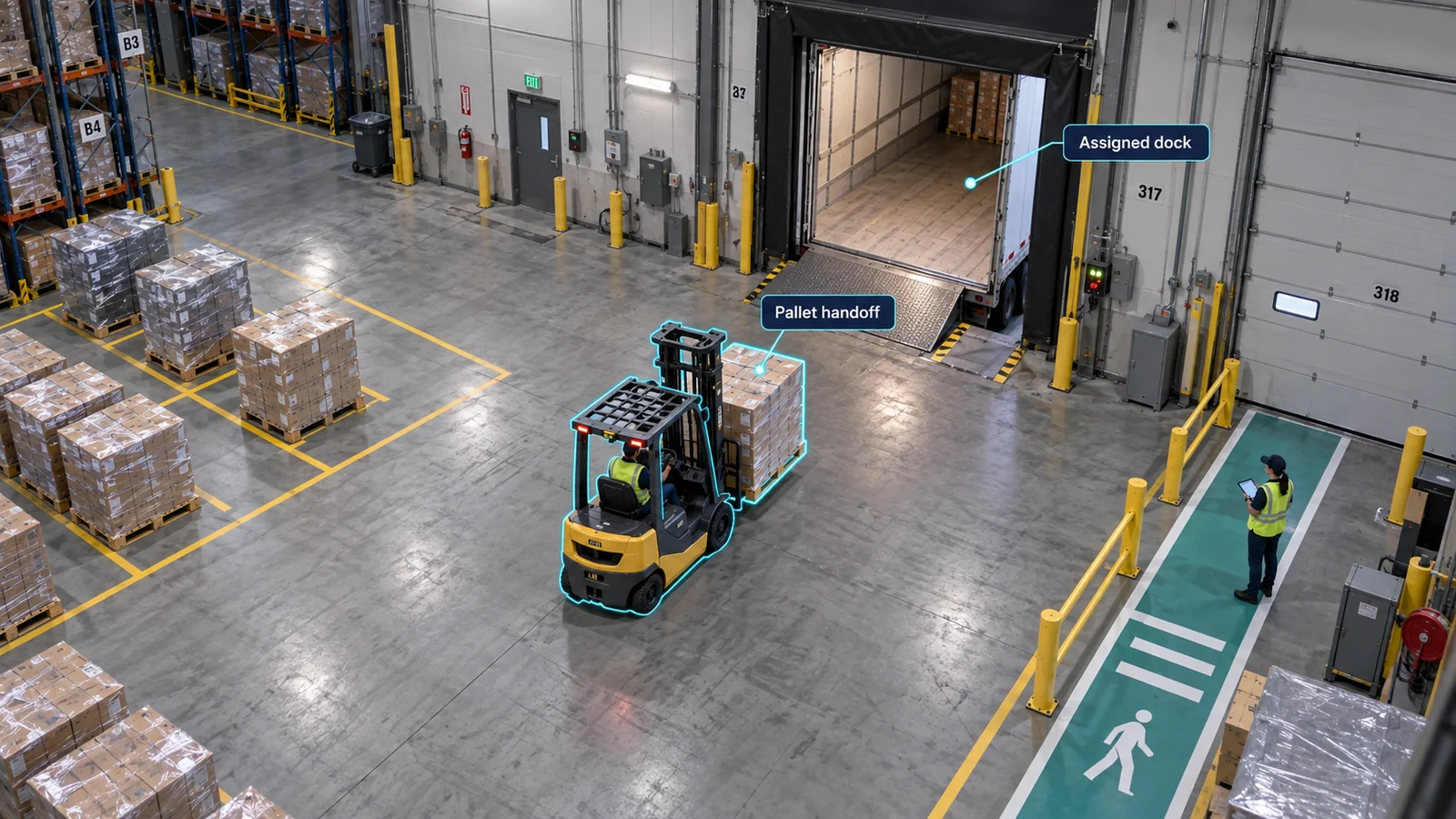
The customer is a warehouse operator in the San Francisco Bay Area that has deployed Fortune AI. Its name remains confidential. The focus of this case study is inventory record accuracy and warehouse productivity.
Those priorities meet at the handoff. A shipment record describes what should move; camera evidence helps review the visible transfer. The same interval can also help identify handling time, waiting, and exception-review work. The approach below connects those operating questions without treating every discrepancy as an inventory error.
See the controls for wrong pallets and short shipments02 · The verification workflow
Expected. Observed. Resolved.
Start with the expected handoff.
Identify the shipment, pallet identifier, assigned dock or trailer, and loading window from authorized operating records. Confirm timestamps and the meaning of each system event.
Find the physical event.
Connect the scan to the relevant camera interval. A readable identifier or another validated link is needed to associate the pallet with its record; similar-looking loads are not enough.
Resolve the record. Find the delay.
Fortune AI brings the expected handoff, observed event, and supporting footage into one review. An authorized supervisor decides what to correct, escalate, or close. For the same covered interval, separate active handling from waiting and record the staff time spent resolving the exception.
Before-departure review depends on the agreed integration and processing latency. Missing footage, occlusion, or an unverified identity stays uncertain—not an automatic error or a cleared shipment.
03 · Evidence and actions
One handoff, two operating decisions.
Use the evidence to resolve the inventory record and to understand how the work moved. A record correction and a process improvement are different actions; keep both traceable.
- Expected
- Shipment reference, pallet identifier, quantity, and assigned destination.
- Observed
- Camera, time interval, visible movement, and the basis for linking the event.
- Evidence
- Relevant scan and clip, with any coverage or identification limits.
- Record action
- Reviewer, confirmed discrepancy, authorized correction or escalation, and closure time.
- Flow action
- Observed handling and waiting intervals, the delay to investigate, and the operational change to test.
A camera can help verify a visible transfer. It cannot establish the contents of a sealed pallet or replace the inventory system. Any WMS write-back requires an agreed integration and authorization.
04 · Productivity measures
Check record accuracy and productive time together.
Agree on the comparison before the pilot. Use comparable shifts and shipment mixes, and include uncertain observations in the evaluation.
Inventory record discrepancies
Count confirmed mismatches between the system record and independently reviewed physical handoffs. Report the reviewed sample and unresolved share separately; an alert is not a confirmed inventory error.
Investigation time
Record active staff minutes spent gathering evidence and resolving each eligible investigation. Separate active work from elapsed waiting time.
Warehouse productivity
Compare completed eligible handoffs per labor hour for the same process and load mix. Join camera-observed events with authorized shift records; video alone does not establish labor hours. Track handling and waiting time separately, without scoring individual workers.
Evidence coverage
Report how many eligible handoffs could be verified, how many remained uncertain, and why footage or records were unavailable.