
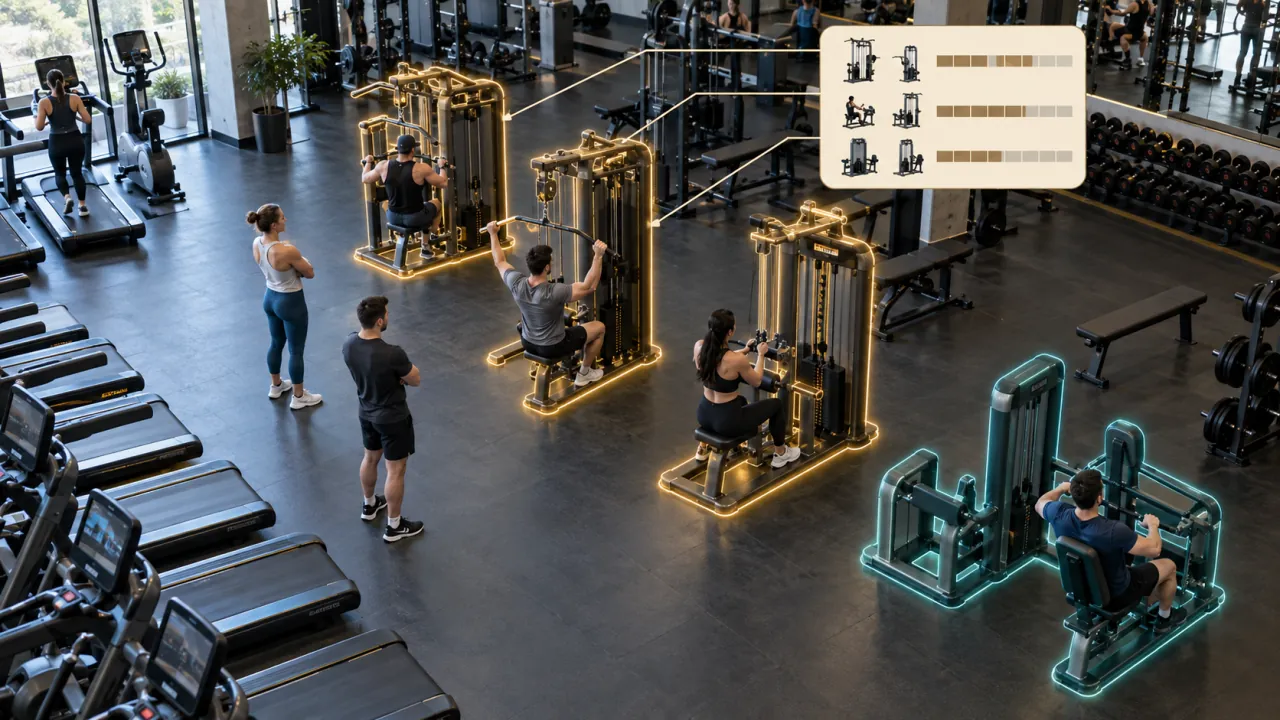
Ask a club manager how busy the gym was last Tuesday at 6 p.m. and you will get a number: check-ins, maybe class bookings. Ask where members were waiting at 6 p.m. and you will usually get a guess.
That difference matters more than it sounds. Most crowding complaints are not about how many people are in the building. They are about one zone, one hour, and one piece of equipment everyone wants at the same time.
A check-in is a visit, not an experience
Membership systems are very good at counting arrivals. Booking systems are good at counting who planned to attend a class. Neither was built to describe the floor.
An entry count tells you 180 people came in between 5 and 7 p.m. It does not tell you that the squat racks had a queue for most of that window while the cable stations two rows over sat half empty. It does not show that a class letting out at 6:15 sends a wave of members into the same strength zone. And it cannot tell you whether the treadmills people complain about were out of order or just busy.
So operators make reasonable decisions with the data they have. They add a class, buy more equipment, or extend staffed hours. Those are expensive answers to a question that has not been fully asked yet.
The strength zone at 6 p.m.
Picture a busy club in a multi-site chain. Member feedback keeps mentioning the free-weight area in the early evening. Check-ins for that window look similar to other weekday peaks. The regional team is considering buying another set of racks.
Before spending on equipment, the club looks at the floor itself, using the camera views it already has and agreed zones. Changing rooms and other private spaces are excluded.
Measure the zone, not the building
The useful view is occupancy and waiting by zone and by time of day, set next to the records the club already keeps: check-ins, class timetables, bookings, and the staffing schedule.
Three things stand out:
- The strength zone fills sharply for about 30 minutes right after the 6 p.m. class ends, then eases
- During that window, members wait for racks while a nearby functional area is close to empty
- Floor staff are posted near the front desk at that time, not on the floor
Capacity across the building is fine. The pressure is one zone for half an hour, created by the timetable and the layout together.
Every heat map needs one decision
This is where many floor-analytics projects stall. The heat map is interesting, it gets shared, and nothing changes. The discipline is to tie each finding to exactly one decision, with an owner and a date. For a peak-hour crowding problem, the decision is usually one of three:
- Class sequence: move or stagger the class that releases members into the busy zone
- Layout or equipment allocation: shift some capacity into the zone that overflows, or open an adjacent area for the same kind of training
- Floor coverage or cleaning window: put a staff member on the floor during the peak, or move a cleaning or maintenance task out of it
The club manager approves one change: the 6 p.m. class ends 15 minutes earlier, and one staff member moves to the strength zone for that window to help members find open equipment. The racks are not purchased yet. The owner is the club manager, and the change starts the following Monday.
Pick one. If the class moves, the layout changes, and staffing shifts in the same week, a better peak teaches you nothing you can repeat at the next club.
Check the same hour next week
The comparison has to match the problem. Monthly averages will not show a 30-minute window. Look at the same weekdays, the same hour, and a similar check-in volume, using the same zone boundaries and the same definition of waiting:
- Did peak occupancy in the strength zone come down, or spread across a longer window?
- Did waiting for racks shrink?
- Did the nearby area pick up use, or did the crowd just move somewhere else?
If waiting dropped and the rest of the floor held, the change becomes part of the club’s operating plan. If it did not, the evidence points to the next option, and the equipment purchase can be judged against real floor data instead of complaints.
Floor evidence next to the records you already keep
This is the loop we run across more than 50 paying sites in five countries, across water safety and fitness: compare the plan with the floor, find the gap, make one change, and verify it on the next comparable period.
For gyms, Fortune AI connects check-ins, bookings, timetables, and staffing schedules with zone occupancy, equipment use, and waiting from agreed camera views. You can see this on our space utilization and occupancy, capacity planning, and equipment utilization pages. Fortune AI proposes the change, the club or facility manager approves it and assigns the owner, and the review reopens at the next comparable peak or class cycle.
Three questions worth asking
- Which zone, at which hour, generates the most crowding complaints?
- What happens on the floor in the 30 minutes after your busiest class ends?
- If you could change one thing next week, how would you know it worked?
Most clubs can answer the first question. Almost none can answer the last two from the front desk.