
Direct answer
How can warehouse managers measure labor productivity?
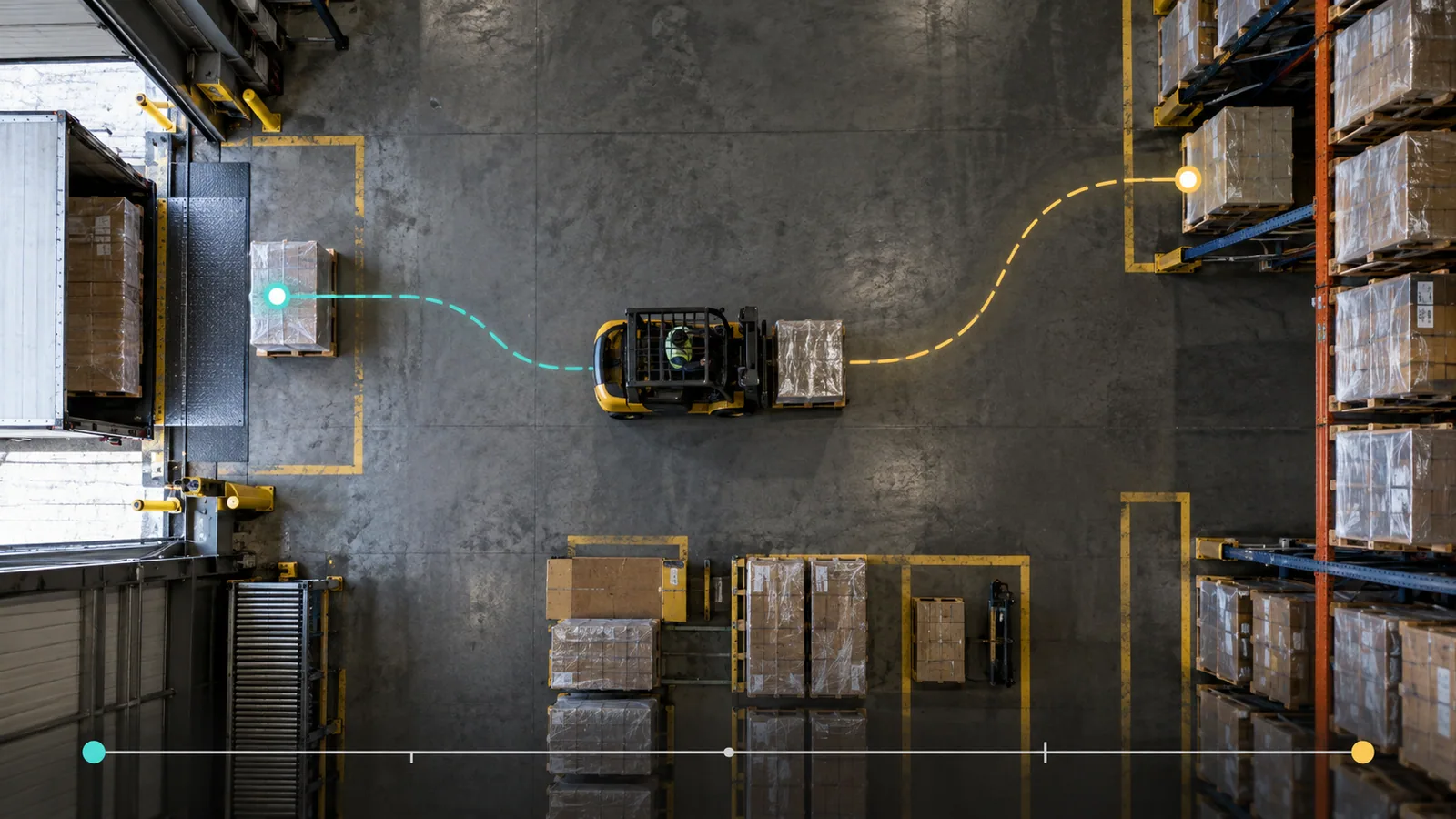
Choose one process and divide a defined completed output by the labor hours used for that same process and period. Then separate visible handling, travel, waiting, and rework to explain why output per labor hour changed. Use authorized WMS and shift records for output and labor hours; use existing cameras only for the visible activity and handoff evidence they cover.
01 · Define the denominator
What is warehouse labor productivity?
Warehouse labor productivity is a process-level relationship between completed output and the labor hours required to produce it. The output may be accepted receipts, completed putaways, picked order lines, packed orders, or shipped loads. Do not combine different processes, load mixes, or definitions into one facility-wide number.
Output record
- Completed unit with a stable system event
- Process, work area, shift, and load class
- Exceptions and rework kept visible
Labor-hour record
- Authorized paid or worked hours for the same process
- Shared labor and breaks handled consistently
- No hours inferred from visual presence alone
Operating context
- Volume, product and order mix
- Staffing plan, equipment availability, and layout
- Comparable shift and observation coverage
02 · Explain the time
Which warehouse work states should be measured separately?
| State | What to observe | Question to investigate |
|---|---|---|
| Handling | Visible picking, packing, loading, unloading, or pallet movement. | Is the process completing the intended unit? |
| Travel | Loaded and empty movement between agreed zones. | Does layout or task sequence create avoidable distance? |
| Waiting | Material, equipment, information, space, or the next handoff is unavailable. | Which upstream rule or constraint owns the wait? |
| Rework or exception | A completed step is repeated or held for review. | Is the cause identity, quantity, quality, system state, or missing evidence? |
03 · Compare matched periods
How should a warehouse productivity baseline be measured?
- Choose one decision. Define the process, output unit, labor-hour source, and team responsible for changing the work.
- Freeze the scope. Set eligible shifts, load or order mix, zones, activity states, exclusions, and minimum camera coverage.
- Join the records. Align completed WMS events and authorized labor hours with camera-observed handling, travel, waiting, and rework.
- Review representative periods. Include normal volume, peaks, changeovers, known exceptions, and missing or occluded intervals.
- Test one operational change. Compare the same process and conditions after changing layout, task release, staging ownership, equipment coverage, or staffing response.
Report output per labor hour together with completed volume, labor hours, wait distribution, rework, missing coverage, and the operating conditions used for comparison.
04 · Protect the boundary
What should warehouse productivity analytics not do?
Do not infer labor hours from visual presence, identify workers, rank individuals, or treat a person waiting as proof of poor performance. Waiting often belongs to an upstream material, equipment, task-release, or space constraint. Keep safety, ergonomics, workload, work pace, breaks, and worker input in the operating review.
Camera-derived activity covers only approved views and periods. Report occlusion, missing footage, timestamp drift, and out-of-view work instead of estimating them.
Define one productivity baselineSources and method
What this guide is based on
This page combines Fortune AI's operating-measurement method with the sources below. It does not report customer performance unless a result is explicitly identified as a customer result.
- Fortune AI warehouse measurement protocolDefinitions, samples, acceptance rules, and reporting limits for camera-derived warehouse measures.
- U.S. Bureau of Labor Statistics productivity definitionLabor productivity describes the relationship between output and the labor hours used to produce it.
- OSHA warehousing hazards and solutionsSafety, ergonomics, workload, work pace, staffing, and worker-input considerations for warehouse operations.